Soil Confinement That Stops Material Movement
Geocell Systems in Shreveport for slope protection, load support, and channel stabilization where three-dimensional confinement prevents soil and aggregate from shifting
In many areas across Louisiana and neighboring states, loose soil or aggregate spreads laterally under load or flows downhill under gravity and water pressure, conditions that cause roads to rut, slopes to slump, and channels to erode through their banks and beds. Southern Geo Supply distributes geocell systems—three-dimensional honeycomb structures that confine soil or aggregate within individual cells, preventing lateral movement while improving load distribution and surface stability. These systems are used in transportation projects, environmental restoration, and industrial sites where material confinement determines whether the installation performs or fails when subjected to traffic, flowing water, or steep grades.
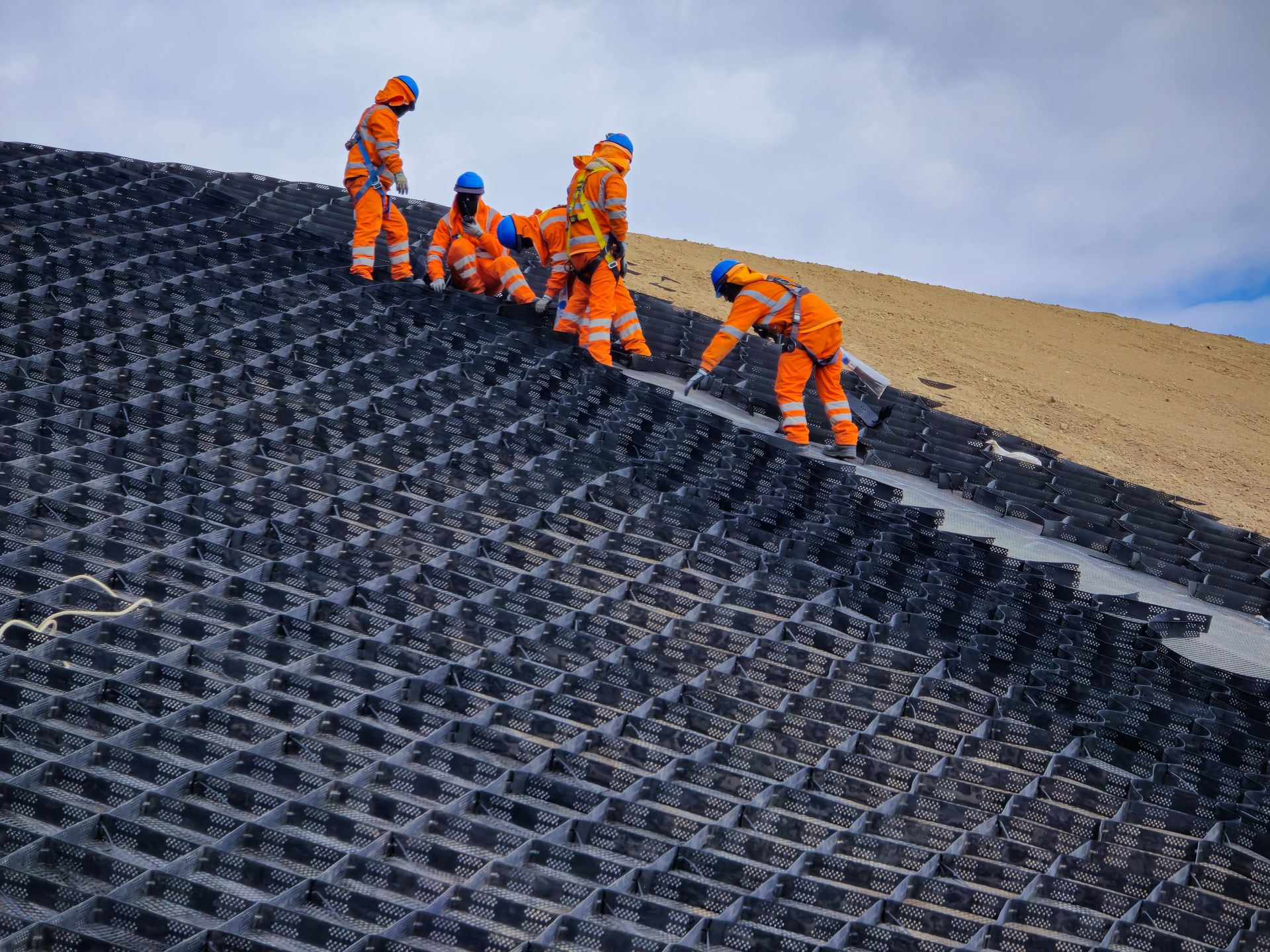
Geocells work by creating cellular confinement that physically restrains infill material, transforming weak or loose soil into a semi-rigid mat that resists shear and erosion. The cell walls transfer loads vertically into deeper soil layers while preventing the horizontal spreading that leads to surface deformation, and they hold infill in place on slopes where unconfined material would wash or slide downhill.
Arrange a discussion about your site's slope angles, load requirements, and soil movement concerns to identify which geocell configuration addresses your application.
What Geocell Confinement Accomplishes
The collapsed geocell panels are expanded on site, anchored with stakes or embedded edges, and filled with soil, aggregate, or concrete depending on the application and required load capacity. Slope installations often use soil infill seeded for vegetation, while roadways and pads use compacted aggregate that locks into the cell structure.
Once loaded and in service, the surface remains stable under repeated traffic without developing ruts because the cell walls prevent aggregate from being pushed laterally out from under wheel paths. Slopes hold their profile and resist erosion because infill material is locked in place even during heavy runoff, and vegetation roots intertwine with the cell structure to add further stability. Channels stabilized with geocells maintain their designed cross-section without undercutting banks or scouring beds, allowing designed flow capacity to continue functioning without ongoing maintenance or reconstruction.
Geocells are available in various cell sizes and wall heights depending on whether the application involves light vehicle access, heavy equipment traffic, steep slope protection, or high-velocity channel flow. Material selection also considers whether infill will be vegetated soil, clean stone, or flowable fill, since each infill type interacts differently with the confinement structure under load and environmental exposure.
Questions Before Starting Your Project
Geocell applications vary widely, and understanding how the system will be loaded and filled determines which product configuration provides adequate confinement without over-specifying cost or installation complexity.
What types of projects benefit most from geocell systems?
Applications where loose material must be confined on slopes steeper than 3:1, roadways over very soft subgrade where conventional base layers would require excessive depth, and channels where bed and bank protection must resist erosive flows without rigid lining.
How does geocell differ from geogrid for load support?
Geocell provides vertical confinement that prevents both lateral and vertical movement of infill, while geogrid primarily reinforces horizontally through tensile strength, making geocell better suited for very weak soils and steep slopes.
When should vegetated infill be used versus aggregate?
Vegetated soil infill works for slopes and areas where aesthetics, erosion control, and lower loads apply, while aggregate infill is necessary for trafficable surfaces and load-bearing applications where vegetation can't provide sufficient strength.
What determines the required cell depth and size for a specific project?
Load magnitude, infill material type, slope angle, and whether the site will experience static loads or repeated traffic cycles all influence which geocell geometry provides adequate confinement without excess material cost.
Why are geocell systems increasingly specified in Shreveport-area projects?
The combination of expansive clay soils, variable moisture conditions, and the need for cost-effective stabilization over large areas makes geocell a practical solution where traditional methods would require more excavation and imported material than budgets allow.
Southern Geo Supply works with project teams to match geocell systems to site-specific conditions, infill availability, and performance requirements. Contact us with your application details and soil data to receive a custom quote and project-specific logistics coordination for material delivery that aligns with your earthwork schedule.